
Badge Awards
At SwimMania, we celebrate every swimmer’s achievements by awarding badges at the end of every other term. Our badge scheme is a fantastic way to recognise progress, build confidence, and give swimmers something exciting to work towards.
Badges are optional and cost £4.00 each. To ensure badges are ready in time for presentation, payment is collected in Week 5 of the term.
If it’s more convenient, you are also welcome to include your badge payment when paying your rebooking fees.
We love celebrating our swimmers’ hard work and look forward to seeing them proudly collecting their well-earned badges!
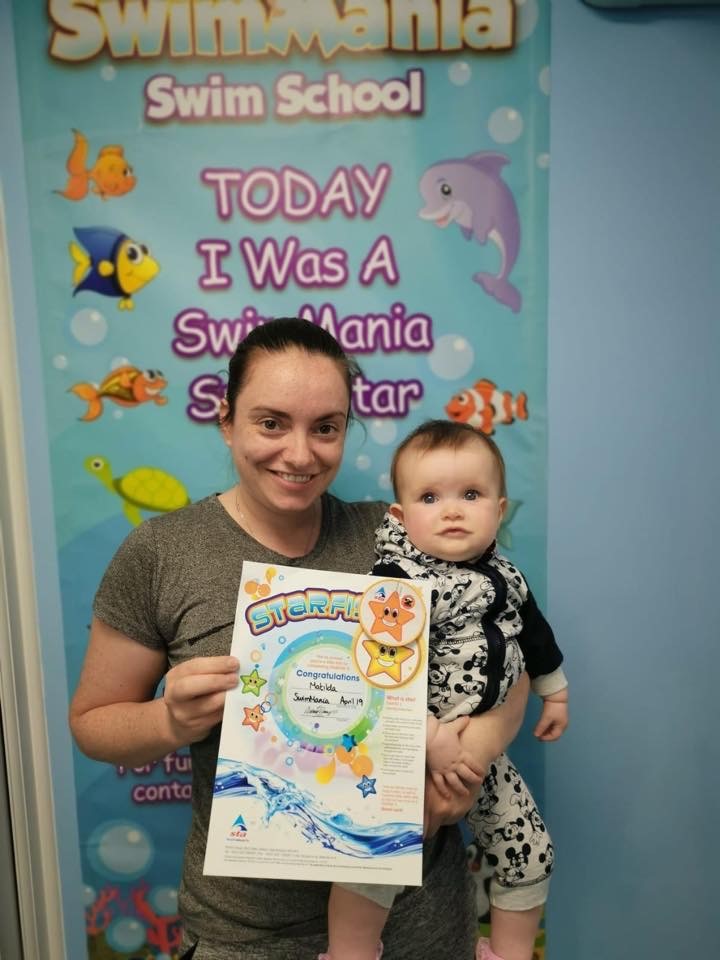
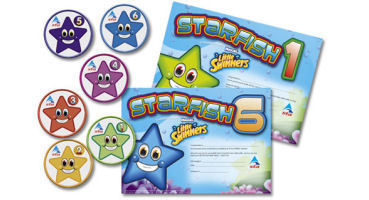
Starfish Awards
(Baby Classes)
Starfish 1
(Aids can be used)
- Help baby enter the pool safely.
- Use swing dips to help familiarise baby with the water.
- Support baby on the front to enable them to move freely around the pool.
- Support baby on the back to enable them to move freely around the pool.
- Encourage baby to wash and splash their face with water.
- Help baby leave the pool safely.
Starfish 2
(Aids can be used)
- Hold baby facing you and submerge yourself in the water for baby to see.
- Enable baby to move freely around the pool using the Safety Hold.
- Move around the pool using the Seat Hold, bobbing baby up and down.
- Support baby on the back while walking backwards and zigzagging through the water.
- Encourage baby to wash their face with water or submerge baby in the water while holding them towards you.
- Encourage baby to hold onto the poolside, with assistance if necessary.
Starfish 3
(Aids can be used)
- Support baby under the arms and encourage them to gently flop into the water from a sitting position.
- Encourage baby to move from front to back positions using a flip-flop rhythmical movement.
- Encourage baby to reach for a toy while moving around the pool, supporting them on the front.
- Help baby move through the water using a kicking action while supporting them on the back.
- Support baby using the Safety Hold, rolling them away from you and then gently back towards you.
- Use a buoyancy aid to support yourself while floating in the water, with baby lying on your chest or sitting on your tummy while making eye contact with you.
Starfish 4
(Aids can be used)
- Support baby by the arms or hands to encourage movement into the pool from a sitting position.
- Use a Forward Hold to encourage and gently submerge baby.
- Use the Little Harbour Hold to move around the pool while encouraging movement from baby.
- Encourage baby to roll from a front position to a back position with support.
- Encourage movement from baby by swiftly walking backwards while supporting them on the back.
- Assist and encourage baby to hold onto the poolside and climb out (if baby has the physical ability).
Starfish 5
(Aids can be used)
- Encourage baby to jump into the water from a standing position on the poolside while holding their arms or hand.
- Support baby while encouraging them to roll from a back position to a front position.
- Encourage baby to make kicking movements with support, either in a Front Surf or with a Woggle.
- Encourage baby, using cues, to submerge in a Duckling Dive.
- Swim around the pool with baby holding onto your back.
- Cue baby to submerge vertically and rotate 180 degrees in the pool.
- Support baby in a front hold to move forwards and grasp a toy, then enable them to return with support in a back float position.
Starfish 6
(Aids can be used)
- Encourage baby to enter the water freely from a sitting position on the poolside.
- Encourage baby to move freely through the water, either with minimal support or with the use of a buoyancy aid.
- Cue baby to submerge vertically and rotate 360 degrees in the pool.
- Support baby by the hands and encourage movement in a figure of eight or snaking pattern through the water.
- Take baby for a front or back ride through the water, with or without support.
- Cue baby to submerge in a Duckling Dive towards the poolside and encourage them to hold onto the poolside and climb out (if baby has the physical ability).
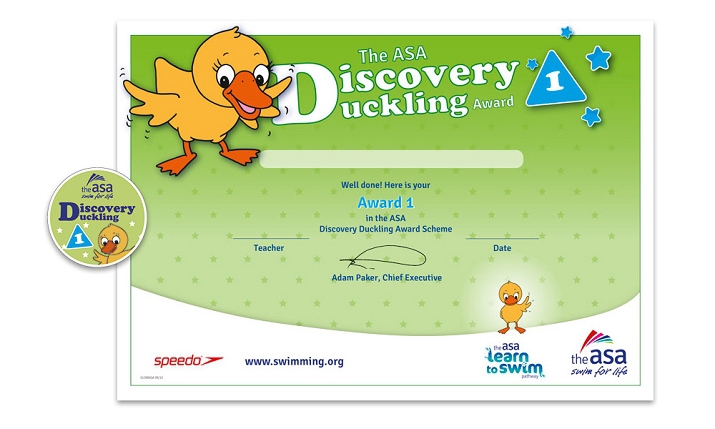
Discovery Duckling
Discovery Duckling 1
(Aids can be used)
By the end of this stage, your child should be able to:
- Enter the water safely and comfortably, fully supported by an adult.
- Bob up and down in the water with full adult support in a vertical position.
- Complete an adult-supported horizontal back float with a return to a vertical position.
- Be at ease with water being poured over the back of the head.
- Move smoothly through the water in a vertical position with full adult support.
- Exit the water safely with adult support.
Discovery Duckling 2
(Aids can be used)
By the end of this stage, your child should be able to:
- Enter the water safely and comfortably, fully supported by an adult.
- Float on their back with full adult support. (The adult should be at the child’s side and able to maintain eye contact.)
- Splash their hands in the water.
- With the adult holding the child facing away from them, move in a 360-degree turn, first close to the adult and then at arm’s length.
- Move through the water in a streamlined position on their back with full adult support.
- Be at ease with their face being washed or splashed.
- Move smoothly through the water in a vertical position with full adult support.
- Travel on the front or back with full adult support.
- Make progress towards holding the side of the pool with adult support.
- Exit the water safely with adult support.
Discovery Duckling 3
(Aids can be used)
By the end of this stage, your child should be able to:
- Enter the water safely with adult support. Swimmers should be encouraged to sit on the poolside and wait for adult instruction.
- Float on their back with full adult support behind the head, shoulders, and hips.
- Reach for and grab toys on the surface of the water.
- Rotate 180 degrees either horizontally or vertically with adult support.
- Move through the water in a streamlined position on their front with full adult support.
- Be at ease with water being showered over their face.
- Travel on their back using buoyancy aids with adult support.
- Hold the rail or side of the pool and move towards the steps or ladder with adult support and buoyancy aids.
- Exit the water safely with adult supervision.
Discovery Duckling 4
(Aids can be used)
By the end of this stage, your child should be able to:
- Enter the water from a seated or standing position with full adult support and return to the wall or poolside.
- Float on their front using buoyancy aids with adult support.
- Reach for and catch toys on the surface of, and underneath, the water.
- Rotate 180 degrees either horizontally or vertically with minimal adult support using buoyancy aids.
- Push away from the wall in a streamlined position while being supported throughout by an adult.
- Be at ease wetting and splashing their own face and putting their chin in the water.
- Travel on their front using buoyancy aids with adult support.
- Hold the rail or side of the pool and move towards the steps or ladder with adult support and buoyancy aids.
- Exit the water safely with adult supervision.
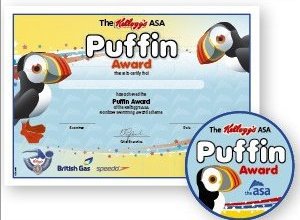
Puffin Award
(Aids can be used)
To achieve the Puffin Award, swimmers should be able to:
- Swim 8 metres using buoyancy aids (such as arm bands or a woggle) without any adult support.
Duckling Awards
Duckling Grade 1
(Aids can be used)
To achieve Duckling Grade 1, swimmers should be able to:
- Make a supervised safe entry with adult support.
- Kick 2 metres on the back with adult support.
- Float on the back with adult support behind the head.
- Blow bubbles at the water surface.
- Wet the head without submersion.
- Travel 2 metres without assistance to a floating object. (It is recommended that an appropriate buoyancy aid is used.)
Duckling Grade 2
(Aids can be used)
To achieve Duckling Grade 2, swimmers should be able to:
- Make a sitting entry with adult support.
- Blow an object for a distance of 2 metres.
- Using a baby seat or other buoyancy aid, rotate through 180° without assistance.
- Move 5 metres along the rail or wall without assistance.
- Travel 3 metres using arms and/or legs without assistance.
- Submerge the face with confidence.
Duckling Grade 3
(Aids can be used)
To achieve Duckling Grade 3, swimmers should be able to:
- Make a supervised jump to an adult, with or without support.
- Kick 5 metres on the front while holding a float. (The adult may hold the other end of the float.)
- Blow bubbles with the mouth underwater.
- Float on the front or back without adult support.
- Travel 5 metres on the front to the side of the pool.
- Show a torpedo shape on the front or back when pushed to a partner.
Duckling Grade 4
(Aids can be used)
To achieve Duckling Grade 4, swimmers should be able to:
- Jump unaided, but supervised, into the water.
- Submerge completely.
- Rotate through 360°, either horizontally or vertically.
- Show a Mushroom Float or a Star Float.
- Travel 10 metres on the front or back without assistance.
- Climb out of the water, with assistance if required.
Duckling Grade 5
(Without the use of buoyancy aids or adult support)
To achieve Duckling Grade 5, swimmers should be able to:
- Show the following sequence: jump into the water, turn around, swim back to the point of entry, and hold the rail or side.
- Submerge completely and blow bubbles underwater.
- Push and glide for a distance of 2 metres on the front or back.
- Float on the front or back and regain a standing/vertical position.
- Swim 5 metres on the front or back using an overwater arm recovery.
- Exit the water safely, showing the correct use of the ladder (or steps if no ladder is available).
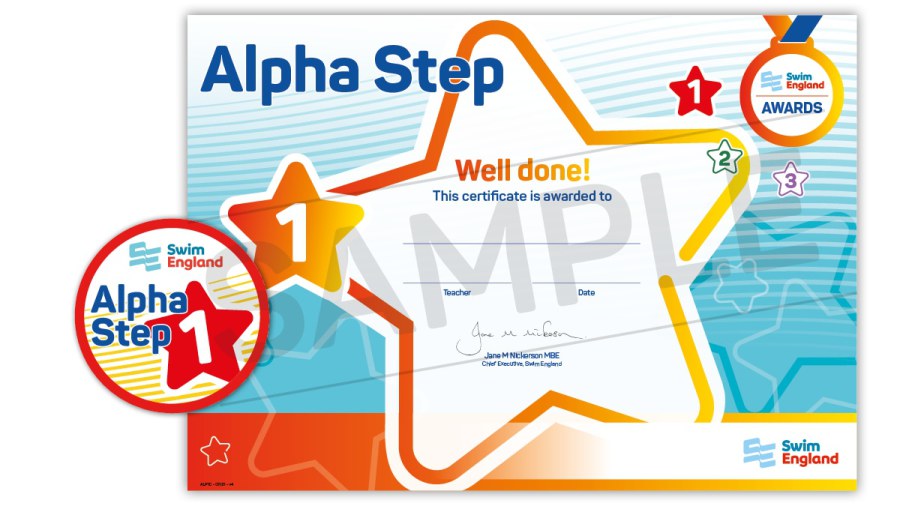
Alpha Steps
Buoyancy aids can be used.
Alpha Step 1
Achieve 6 out of the 22 skills.
Alpha Step 2
Achieve 12 out of the 22 skills.
Alpha Step 3
Achieve 17 out of the 22 skills.
Entries
- Enter the water safely with equipment or support.
- Enter the water safely with minimal support.
- Enter the water safely without assistance or support.
Aquatic Breathing
- Blow or move a floating object over a distance of 3 metres.
- Tolerate the face being splashed.
- Wet the mouth and blow bubbles.
Spatial Awareness
- While remaining on the spot, move a selected object around.
- While travelling, move an object through the water.
- Move an object to or from a partner in various directions.
Rotation
- Be rocked through the water with adult support.
- Turn through 360 degrees with minimal assistance.
- Lie back and return to a vertical position with support.
Buoyancy
- Float with support.
- Float on the front with support.
- Float on the back with support.
Coordination
- Be towed in various directions.
- Travel through the water with minimal support.
- Travel on the front with or without floats.
- Travel on the back with or without floats.
Exits
- Exit the water safely using equipment and with minimal support.
- Exit the water safely with minimal support.
- Exit the water safely without support.

Stanley Seal Awards
Buoyancy aids can be used unless otherwise stated.
Stanley Seal 1
- Identify the teacher.
- Enter the water safely.
- Splash the feet on the water’s surface while holding the poolside.
- Walk 5 metres forwards, backwards and sideways through the water.
- Travel 2 metres on the front, turn and return to the starting point.
- Travel 2 metres on the back, roll over and regain a standing position.
- Blow a small floating object across the water for 2 metres.
- Travel underneath a woggle while a watering can is used as a shower.
- Push and glide on the front.
- Exit the pool safely.
Stanley Seal 2
Stanley Seal 2 helps children develop an understanding of poolside safety, master blowing bubbles with both the nose and mouth submerged, move confidently through the water, return to standing, float, roll and push and glide.
What you will learn
- Show an understanding of poolside safety.
- Enter the water safely from the poolside.
- Blow bubbles with both the nose and mouth submerged.
- Travel 2 metres on the front while blowing bubbles and return to a standing position.
- Travel 2 metres on the back using an alternating leg action while looking at the ceiling, then return to standing.
- Perform a star float.
- Use a front paddle action to move a ball across the pool.
- Push and glide on the back.
- Roll from the front onto the back while looking at the ceiling.
- Climb out of the pool safely.
Stanley Seal 3
After completing Stanley Seal 3, children will gain even more confidence in the water. They will be able to enter the pool, move away from and return to the side, confidently perform a star float, travel 5 metres on both the front and back, and develop essential water safety skills.
What you will learn
- Answer one question on poolside safety.
- Enter the water from the poolside, travel forwards for 1 metre, return to the side and exit the pool independently.
- Put the face in the water and blow bubbles.
- Perform a star float and regain a standing position.
- Travel 5 metres on the back using an alternating leg action.
- Travel 5 metres on the front using a front paddle action.
- Perform a 360° turn with the feet off the pool floor.
- Roll from the back onto the front and back again.
- Jump into the water from the poolside with hand support from a parent or carer.
- Perform a treading water action using a woggle (Seahorses).
Stanley Seal 4
Building on the skills learned in Stanley Seal 3, children will begin retrieving objects from below the water’s surface, improve their push and glide, jumping and rolling skills, and start developing the foundations of recognised swimming strokes.
What you will learn
- Answer two questions on poolside safety.
- Swim 5 metres using a front paddle action, tuck and roll onto the back, then swim 5 metres on the back.
- Bob up and down, submerging the face four times while exhaling underwater.
- Retrieve an object from below the water’s surface.
- Perform two different floating positions.
- Push and glide on the back, tuck and return to the side on the front.
- Perform a treading water action using both arms and legs.
- Attempt a circular action with either the arms or legs.
- Jump safely into the pool independently.
- Climb out of the pool safely without assistance.
Stanley Seal 5
Stanley Seal 5 introduces more detailed breathing techniques for front crawl and back crawl. Children will also retrieve objects from the pool floor, tread water and develop confident push and glide skills.
What you will learn
- Answer two questions on poolside rules.
- Swim 2 metres using either a front paddle or back paddle.
- Hold three different floating positions for 3 seconds each.
- Breathe rhythmically for four breathing cycles while supported or moving.
- Jump in from the poolside, tread water, turn around and swim back to the wall.
- Push off on the back and swim 5 metres using a simultaneous leg action.
- Push and glide on the front with the face in the water while blowing bubbles.
- Retrieve an object from the bottom of the pool.
- Demonstrate front crawl arm action.
- Demonstrate back crawl arm action.
Stanley Seal 6
In the penultimate Stanley award, children will swim confidently through a submerged hoop, change from front to back swimming, develop breaststroke leg action and begin learning sculling skills.
What you will learn
- Answer two water safety questions.
- Push and glide on the back.
- Swim through a submerged hoop.
- Swim 3 metres using a breaststroke-style leg action while holding two floats or a woggle.
- Swim 2 metres on the front and transition smoothly into 2 metres of back paddle.
- Perform a star or pencil jump into the pool, tread water and return to the poolside.
- Hold the side of the pool and push off underwater.
- Swim on the front, tuck and return swimming on the back.
- Swim 5 metres using either front crawl or backstroke.
- Using a woggle, scull forwards, backwards or in a circle.
Stanley Seal 7
Stanley Seal 7 is the final award in the series. Children will confidently combine all of the skills they have developed, including front crawl, backstroke, breaststroke, sculling, dolphin kick, treading water and underwater skills.
What you will learn
- Answer three water safety questions.
- Perform a star float, slowly change to a narrow float and return to a star float on either the front or back.
- Push and glide on the back with arms extended before rolling onto the front.
- Swim 2 metres using a dolphin kick on either the front or back.
- Tread water for 10 seconds.
- Swim 5 metres using a breaststroke-style arm and leg action.
- Swim 10 metres front crawl confidently while attempting side breathing.
- Swim 10 metres confidently on the back.
- Swim through a submerged hoop and retrieve an object.
- Using a woggle, scull headfirst using the arms only.
Stanley Star Award
What you will learn
- Answer four water safety questions.
- Push and glide into a confident 10 metre swim.
- Push and glide or swim through a submerged hoop, retrieve an object and return to the side.
- Using a float, kick on the front while collecting four floating objects before returning to the side.
- Swim 2 metres on the back, roll onto the front and swim 2 metres, then roll onto a star float on the back.
- Push and glide on the back, kick for 2 metres, tuck and roll, then swim back to the side on the front.
- Kick 5 metres on the back while balancing a toy on a float.
- Jump into the water, swim to a raft, climb on and sit down.
- Jump into the water, tread water while turning around, then swim back to the side.
- Exit the pool safely by climbing out and leaving the poolside safely.
STA Octopus Awards
Octopus Award 1
Buoyancy aids can be used.
What you will learn
- Answer two water safety questions.
- Enter the pool safely and independently using the steps, ramp or pool swivel.
- Move through the water by walking, hopping, skipping or jumping.
- Using a woggle, swim 5 metres using front paddle and back paddle.
- Push and glide on both the front and back.
- Attempt a simultaneous circular leg action on the back for 2 metres using a woggle or floats.
- Travel underneath a woggle bridge and through a watering can shower.
- Return to a standing position from a star float on the back.
- Using a woggle (Seahorses), perform a treading water action with the legs.
- Exit the pool safely and independently.
Octopus Award 2
Buoyancy aids can be used.
What you will learn
- Answer two water safety questions.
- Enter the pool safely using either a step or a jump.
- Swim 2 metres front paddle and 2 metres back paddle without aids.
- Using a woggle, kick across the pool while blowing bubbles.
- Demonstrate front crawl arm action while standing.
- Demonstrate back crawl arm action while standing.
- Push and glide on the front with the face in the water.
- Push and glide on the back with the arms by the sides.
- Rotate from a back float to a front float and return to a back float (a woggle may be used).
- Fully submerge and retrieve an object from the pool.
Octopus Award 3
What you will learn
- Answer two water safety questions.
- Enter the pool with either a step or a jump, turn around and swim back to the side.
- Push and glide on the front, then swim 5 metres.
- Push and glide on the back, then swim 5 metres.
- Perform a star float on either the front or back and hold the position for 3 seconds.
- Perform a dolphin kick on either the front or back for 2 metres.
- Scull headfirst using a woggle.
- Attempt breaststroke (a woggle may be used).
- Tread water for 10 seconds.
- Swim 2 metres on the front, roll onto the back and swim 2 metres, then roll back onto the front and return to a standing position.

Swim England Learn to Swim Awards
The Swim England Learn to Swim Awards (Stages 1–7) are divided into progressive stages that form the core national syllabus for teaching primary school-aged children to swim.
The awards are designed to reward children as they develop the essential aquatic skills needed to become confident, competent and safe in the water. Each stage has a clear set of outcomes that must be achieved before the award is completed.
⸻
Stage 1
Buoyancy aids can be used.
By completing this award, with or without flotation equipment or support, swimmers will be able to:
- Enter the water safely.
- Move forwards for 5 metres (feet may be on or off the pool floor).
- Move backwards for 5 metres (feet may be on or off the pool floor).
- Move sideways for 5 metres (feet may be on or off the pool floor).
- Scoop water and wash the face.
- Be comfortable with water showered from overhead.
- Move from a flat floating position on the back and return to standing.
- Move from a flat floating position on the front and return to standing.
- Push and glide in a flat position on the front from the wall.
- Push and glide in a flat position on the back from the wall.
- Give examples of two pool rules.
- Exit the water safely.
⸻
Stage 2
By completing this award, with or without flotation equipment or support, swimmers will be able to:
- Jump safely into water with a minimum depth of 1 metre.
- Blow bubbles rhythmically at least three times with both the nose and mouth submerged.
- Move from a flat floating position on the back and return to standing without support.
- Move from a flat floating position on the front and return to standing without support.
- Push from the wall and glide on the back with arms by the sides or extended above the head.
- Push from the wall and glide on the front with arms extended.
- Travel 5 metres on the back using a recognised leg action with the feet off the pool floor.
- Travel 5 metres on the front using a recognised leg action with the feet off the pool floor.
- Perform a tuck to rotate from a front float to a back float, then return to standing.
- Perform a tuck to rotate from a back float to a front float, then return to standing.
- Perform a log roll from the back onto the front.
- Perform a log roll from the front onto the back.
- Exit the water independently.
⸻
Stage 3
By completing this award, without flotation equipment or support, swimmers will be able to:
- Jump into the water from the poolside and submerge in water with a minimum depth of 1 metre.
- Sink, push away from the wall and maintain a streamlined position.
- Push and glide on the front with arms extended and log roll onto the back.
- Push and glide on the back with arms extended and log roll onto the front.
- Travel 5 metres on the front, perform a tuck to rotate onto the back and return on the back.
- Fully submerge to retrieve an object.
- Correctly answer three questions about the Water Safety Code.
- Push and glide, then swim 10 metres on the back.
- Push and glide, then swim 10 metres on the front.
- Perform a tuck float and hold the position for 3 seconds.
- Exit the water without using the steps.
⸻
Stage 4
By completing this award, without flotation equipment or support, swimmers will be able to:
- Perform a sequence of at least three different floating shapes while demonstrating an understanding of buoyancy.
- Push and glide from the wall towards the pool floor.
- Kick 10 metres backstroke (one item of equipment may be used).
- Kick 10 metres front crawl (one item of equipment may be used).
- Kick 10 metres butterfly on either the front or back.
- Kick 10 metres breaststroke on the front (one item of equipment may be used).
- Perform a head-first sculling action for 5 metres in a flat position on the back.
- Travel on the back and perform a continuous log roll onto the front.
- Travel on the front and perform a continuous log roll onto the back.
- Push and glide before swimming 10 metres using any recognised stroke.
⸻
Stage 5
By completing this award, swimmers will be able to:
- Perform a stationary flat scull on the back.
- Perform a feet-first sculling action for 5 metres in a flat position on the back.
- Perform a partnered sculling sequence lasting 30–45 seconds that includes a rotation.
- Tread water for 30 seconds.
- Perform three different shaped jumps into deep water.
- Push and glide, then swim 10 metres backstroke to Swim England expected standards.
- Push and glide, then swim 10 metres front crawl to Swim England expected standards.
- Push and glide, then swim 10 metres breaststroke to Swim England expected standards.
- Push and glide, then swim 10 metres butterfly to Swim England expected standards.
- Perform a handstand and hold for at least 3 seconds.
- Perform a forward somersault.
- Demonstrate an appropriate method of getting help.
⸻
Stage 6
By completing this award, swimmers will be able to:
- Give two examples of how to prepare for exercise and explain why preparation is important.
- Sink, push off from the wall, glide, kick and rotate into backstroke.
- Sink, push off from the wall, glide, kick and rotate into front crawl.
- Swim 10 metres while wearing clothes.
- Push and glide, then swim front crawl including at least six rhythmical breaths.
- Push and glide, then swim breaststroke including at least six rhythmical breaths.
- Push and glide, then swim butterfly including at least three rhythmical breaths.
- Push and glide, then swim backstroke including at least six regular breaths.
- Push and glide, then swim 25 metres using a stroke of choice to Swim England expected standards.
- Perform a “Shout and Signal” rescue.
- Perform a surface dive.
⸻
Stage 7
By completing this award, swimmers will be able to:
- Push and glide, then swim 25 metres backstroke to Swim England expected standards.
- Push and glide, then swim 25 metres front crawl to Swim England expected standards.
- Push and glide, then swim 25 metres breaststroke to Swim England expected standards.
- Push and glide, then swim 25 metres butterfly to Swim England expected standards.
-
Perform a one-minute movement sequence, in a group of three or more, linking strokes, sculling and aquatic skills. This should include a selection of the following:
- Sculling: Head first and feet first
- Rotation: Forward somersault, backward somersault or log roll
- Floating: Star float (front or back), tuck float or a self-created float
- Eggbeater: Travelling while lifting one or both arms out of the water
- Perform a sitting dive or a dive.
- Push and glide, then swim 50 metres continuously using one stroke to Swim England expected standards.
- Push and glide, then swim 100 metres continuously using a minimum of three different strokes to Swim England expected standards.
- Tread water using an eggbeater action for 30 seconds.
- Complete an obstacle course using a minimum of four objects while keeping the feet off the pool floor throughout.
Water Skills Awards
For each Water Skills Award, swimmers must successfully complete:
- 8 out of the 10 skills to achieve the award.
- 6 out of the 10 skills for swimmers with a disability.
Buoyancy aids may be used for Water Skills Grade 1.
Water Skills Grade 1
What you will learn
- Move across the pool with the water no lower than shoulder depth.
- Submerge the face and blow bubbles underwater for 3 seconds.
- Push and glide from the poolside or pool bottom on the front and return to a resting or standing position.
- Push and glide from the poolside or pool bottom on the back and return to a resting or standing position.
- Travel a minimum of 5 metres on the back.
- Travel a minimum of 5 metres on the front.
- Rotate from the back to the front and regain a resting or standing position.
- Propel a floating object (such as a ball) for 3 metres using any method.
- Demonstrate either a horizontal or vertical stationary floating position for 10 seconds.
Water Skills Grade 2
What you will learn
- Enter shallow water independently from either a standing or sitting position without using the steps.
- Fully submerge the head and exhale underwater for a minimum of 3 seconds.
- Hold a tucked floating position for at least 5 seconds. This may be performed on the front or back, with the face either submerged or above the water.
- Swim one width on the front using a crawl-type front paddle action.
- Swim one width on the back using a crawl-type leg action.
- Swim one width on either the front or back using a breaststroke-style action.
- Swim one width using a full stroke on either the front or back with arm recovery over the water.
- Demonstrate either a horizontal or vertical floating position for 20 seconds.
- Perform a 360° turn or roll from either a horizontal or vertical position without touching the pool bottom.
- Swim two widths continuously using any stroke or combination of strokes.
Water Skills Grade 3
What you will learn
- Jump into water that is at least full reach depth.
- Swim four widths continuously using any stroke or combination of strokes.
- Submerge in shallow water and retrieve an object from the pool bottom using both hands.
- Tread water out of standing depth using the arms and/or legs for 20 seconds.
- Swim two widths on the front demonstrating good technique.
- Swim two widths on the back demonstrating good technique.
- Swim a minimum of 10 metres, changing direction at least three times without touching the side or bottom of the pool.
- Scull headfirst for 5 metres.
- Swim through a submerged hoop in shoulder-depth water.
- Swim continuously for 1 minute using two different strokes with good technique.
Water Skills Grade 4
What you will learn
- Jump into water that is at least full reach depth and swim 25 metres without touching the side or bottom.
- Perform a surface dive in water of at least full reach depth using good technique.
- Perform a forward somersault, using a push and glide if required.
- Swim 25 metres front crawl or breaststroke demonstrating good technique.
- Swim 25 metres backstroke demonstrating good technique.
- Scull headfirst for 5 metres, then return by sculling feet first.
- Swim a minimum of 5 metres using a dolphin leg action.
- Swim two widths using any recognised stroke, including a correct turn in accordance with ASA Law.
- Enter water that is at least full reach depth, tread water for 20 seconds and then swim 25 metres.
- Swim underwater for 5 metres.
Water Skills Grade 5
What you will learn
- Tread water for 30 seconds, then swim 25 metres, passing through a submerged hoop.
- Perform a backward somersault, using a push and glide if required.
- Perform a surface dive in water of at least full reach depth followed by an underwater swim of at least 5 metres.
- Swim 50 metres within 90 seconds.
- Swim 25 metres using either inverted breaststroke or backstroke.
- Perform a headfirst entry into water of at least full reach depth and swim 25 metres front crawl.
- Swim one width of front crawl, finish with a forward somersault into the poolside, then push and glide away on either the front or back.
- Swim one width of butterfly.
- Jump into water that is at least full reach depth, achieving good height and an upright position in flight.
- Swim 25 metres while propelling a ball and maintaining close control throughout.
Water Skills Grade 6
What you will learn
- Swim 75 metres within 2 minutes using three different strokes while demonstrating good technique.
-
Perform the following skills continuously without pausing:
- Headfirst scull for 5 metres
- Somersault
- Feet-first scull for 5 metres
- 360° rotation in a vertical tucked position
- Swim three widths of front crawl, demonstrating good technique and completing two appropriate turns.
- Swim three widths of backstroke, demonstrating good technique and completing two backstroke turns.
- Swim three widths of breaststroke, demonstrating good technique and completing two breaststroke turns.
- Swim two widths of butterfly.
-
Perform two different jumps into water that is at least full reach depth, gaining height and adopting different flight positions selected from:
- Straight
- Tuck
- Pike
- Turning
- Somersault
- Propel a ball for a minimum of 25 metres while maintaining close control and demonstrating at least two changes of direction of 90° or more.
- Perform a plunge dive into water that is at least full reach depth, maintaining a glide for 5 metres.
- Perform a plunge dive into water that is at least full reach depth and tread water for 1 minute.
Angelfish Awards
Angelfish 1
What you will learn
- Be rescued using a reaching aid.
- Perform a straddle entry and tread water for 30 seconds. If the water is too shallow, perform a step entry and support scull for 30 seconds instead.
- Push and glide into a forward somersault.
- Scull headfirst for 5 metres and feet first for 5 metres.
- Swim 15 metres of a recognised front stroke with correct breathing (learner’s first choice).
- Swim 10 metres of a recognised front stroke with correct breathing (learner’s second choice).
- Swim 20 metres back crawl.
- Swim 10 metres on the front using a dolphin leg kick without aids.
- Start in a crouched position in the water, spring upwards, glide to the pool floor, then glide back to the surface.
- Swim 5 metres of lifesaving backstroke without aids.
Angelfish 2
What you will learn
- Be rescued by catching a buoyant aid.
- Perform a straddle entry, tread water for 30 seconds and complete a 360° turn in a vertical position while wearing a T-shirt. If the water is too shallow, perform a step entry, support scull for 30 seconds and complete the 360° turn instead.
- Swim 5 metres, perform a forward somersault and continue swimming for a further 5 metres.
- Swim 20 metres of a recognised front stroke using a correct touch finish (learner’s first choice).
- Swim 15 metres of a recognised front stroke using a correct touch finish (learner’s second choice).
- Swim 20 metres back crawl using a correct touch finish.
- Swim 5 metres on the back using a double-arm action and dolphin leg kick.
- Swim 5 metres on the side using a dolphin leg kick.
- Start in a crouched position in the water, spring upwards, glide to the pool floor, tuck, place both feet on the pool floor and spring back to the surface. (To be performed in chest-deep water.)
- Swim underwater for 5 metres.
Angelfish 3
What you will learn
- Be rescued by catching a rope.
- Perform a straddle entry and tread water for 30 seconds while wearing a T-shirt. Remove the T-shirt in the water and climb out of the pool independently. If the water is too shallow, perform a step entry and support scull instead.
- Perform both a head-first and a feet-first surface dive. If the water is too shallow, perform an underwater push and glide to the pool floor instead.
- Scull feet first for 10 metres and headfirst for 10 metres.
- Swim 25 metres back crawl using a correct finish.
- Swim 25 metres of a recognised front stroke using a correct finish (learner’s first choice).
- Swim 20 metres of a recognised front stroke using a correct finish (learner’s second choice).
- Swim 5 metres butterfly.
- Push and glide into a handstand.
- Perform a sitting dive where the water depth allows. If the water is too shallow, perform an underwater push and glide, roll onto the back while underwater and surface in a back glide.

Goldfish Awards
Goldfish 1
What you will learn
- Answer two water safety questions.
- Enter the water using either a step or jump entry, tread water for 5 seconds, then swim to the poolside.
- Push and glide, holding a streamlined position for 5 seconds.
- Push and glide, or swim to the bottom of the pool, to retrieve an object.
- Swim 5 metres on the front, roll onto the back and swim a further 5 metres.
- Perform a dolphin leg kick on either the front or back for 5 metres.
- Scull headfirst for 2 metres.
- Scull feet first using a woggle for support.
- Demonstrate rhythmical breathing in front crawl for 10 metres using a woggle or float.
- Swim 5 metres of recognisable breaststroke.
Goldfish 2
What you will learn
- Answer two water safety questions.
- Perform a back float, tuck to a front float and return to a standing position.
- Scull headfirst for 5 metres and feet first for 3 metres.
- Push and glide on the back, tuck, rotate onto the front and return to the starting point.
- Swim 10 metres of a recognised front stroke (either front crawl or breaststroke) using the learner’s first choice.
- Swim 10 metres back crawl.
- Swim 5 metres of a recognised front stroke using the learner’s second choice.
- Push and glide to the bottom of the pool, tuck, place both feet on the pool floor and spring back to the surface.
- Perform a mushroom float and hold for 3 seconds, extend into a front float and return to a standing position.
- Enter the water using either a step or jump entry, swim 5 metres on the front, then swim to the poolside and exit the water safely.
Goldfish 3
What you will learn
- Answer two water safety questions.
- Perform two different types of entries and tread water for 15 seconds after each entry. (To be performed in shoulder-depth water.)
- Swim 15 metres of a recognised front stroke (either front crawl or breaststroke).
- Swim 10 metres using a lifesaving backstroke leg kick while holding a float under each arm.
- Swim 5 metres using a dolphin leg kick on the front.
- Swim 5 metres using a dolphin leg kick on the back.
- Perform a handstand with both hands on the pool floor. (To be performed in chest-depth water.)
- Perform a horizontal back float and hold for 5 seconds, roll onto the front and hold for 5 seconds, then roll back onto the original back float and hold for a further 5 seconds.
- Submerge, push and glide on the side, then roll into a face-down position.
Shark Award
What you will learn
- Perform a Shout and Signal rescue to a weak swimmer who is 5 metres away.
- Enter the water using a slide-in entry, swim 10 metres while wearing a T-shirt, tread water for 30 seconds, remove the T-shirt in the water and climb out of the pool independently.
- Swim 5 metres of a recognised front stroke, perform a head-first surface dive and continue with a 5-metre underwater swim.
- Swim 5 metres of a recognised front stroke, perform a feet-first surface dive, tuck and continue with a 5-metre underwater swim.
- Swim 50 metres of a recognised front stroke (learner’s first choice).
- Swim 50 metres back crawl.
- Swim 25 metres of a recognised front stroke (learner’s second choice).
- Swim 25 metres of Old English backstroke.
- Swim 25 metres front crawl demonstrating bilateral breathing.
- Perform a kneeling dive where the water depth allows. If the water is too shallow, perform an underwater push and glide for 5 metres instead.




 Print
Print 